
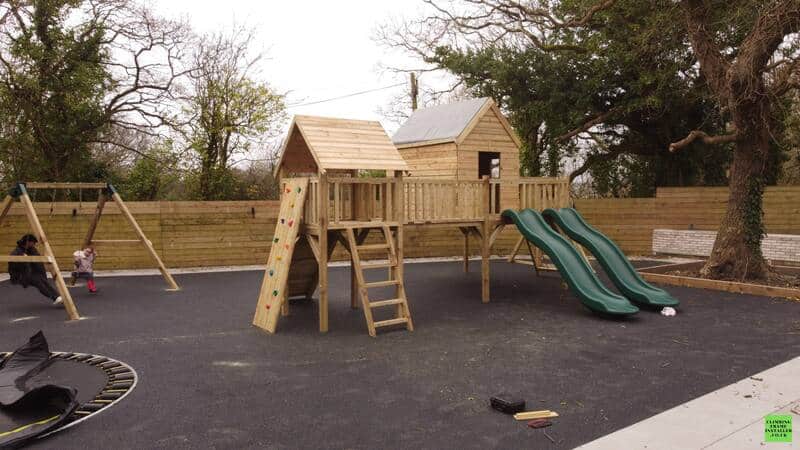
When choosing where to install a climbing frame, deck height and ground surfacing need to be considered together. A suitable surface can help reduce the severity of an impact, but it must be appropriate for the height and type of play equipment. The surrounding space matters too.
Understanding a few key terms can help families, schools and nurseries plan a play area more confidently.
What does critical fall height mean?
Critical fall height (CFH) describes the maximum fall height for which a surfacing material has been tested to provide impact attenuation. In simple terms, it is the height the surface is rated to protect against under the relevant test conditions.
The equipment has a related measurement: its free height of fall. This is the distance from the highest part a child can reasonably stand or climb on to the surface below. It is not necessarily the full height of the frame. For example, if the accessible platform is 1.5 metres above the ground, its height is an important starting point when assessing the landing surface.
The basic principle is that the surfacing’s tested critical fall height should be at least as high as the equipment’s free height of fall. Check the equipment manufacturer’s information and have the site assessed where the height or layout is unclear.
Why deck height affects surfacing
A raised deck gives children a greater distance to fall. As that distance increases, the surface needs to provide suitable impact attenuation across the relevant landing area.
A tower with a 1.5-metre deck should not be assumed safe over ordinary lawn alone. Grass condition varies, and wear, compacted soil, stones, roots or bare patches can affect how it performs. Some natural grass may be suitable in particular circumstances, but it needs to be assessed and maintained. If its suitability cannot be established, specify tested impact-absorbing surfacing rated for the fall height.

Also check every accessible standing or climbing point, not just the main deck. A climbing wall, platform or bridge may create another potential fall point. Where ground slopes, the distance to the landing surface can change around the frame, so the whole layout should be considered.
How common surfacing options relate to fall height
Different materials can be suitable, provided the particular product and installation are appropriate for the equipment’s fall height.
- Safety mats or tiles: These can provide a defined impact-absorbing area. Check the product’s tested fall-height rating, coverage and installation instructions. Gaps or movement may reduce performance.
- Rubber and wetpour: These create a continuous surface and can be specified for different fall heights. The correct material build-up and installation matter; the name of the surface alone does not confirm its rating.
- Bark or other loose-fill surfacing: Use suitable play-grade material and install it to the required depth. Loose-fill can move, compact or disperse, so it needs regular checks and replenishment.
- Grass: Do not treat a lawn as a guaranteed impact surface. Its suitability depends on its condition, underlying ground and ongoing maintenance, as well as the fall height and wear expected at the site.

Always ask for product information or test evidence showing the surfacing’s critical fall height. For a school, nursery or public play area, the design should also account for inspection and maintenance over time.
Plan the safety zone as well as the surface
Impact-absorbing surfacing needs to cover the relevant impact area, not just the patch directly beneath a tower. Leave sufficient clear space around the equipment for children to fall without striking a fence, wall, tree, edging or another structure.
The required area depends on the equipment. Swings, slides and other moving equipment need specific consideration because a child may travel beyond the point directly beneath the structure. Do not assume the same clearance applies to every feature. Follow the manufacturer’s layout instructions and applicable safety guidance, and avoid placing hard obstacles within the relevant zones.
When planning a sloping garden, consider how the slope affects both the fall distance and the installation of the surface. Drainage and erosion also matter: a surface that shifts, wears through or becomes uneven may need attention to remain suitable.

A practical checklist before installation
Before building or buying surfacing, confirm:
- The highest accessible play point and its free height of fall.
- The surfacing’s tested critical fall height and required installation details.
- The impact area for each feature, including swings and slides.
- Whether the ground is level, stable and well drained.
- How the surface will be checked, repaired or topped up over time.
For commercial settings, seek a competent assessment against the relevant playground equipment and surfacing standards, including BS EN 1176 and BS EN 1177. The BS EN 1177 surfacing test standard explains the testing framework for impact-attenuating surfaces.
Get advice on your play area
The right combination of frame, surfacing and layout helps create a play space that is practical to use and easier to maintain. Climbing Frame Installer installs pre-purchased equipment and designs and builds bespoke playsets, tree houses and play areas, including installations on slopes, across England and Wales.
For help planning an installation or choosing suitable surfacing, call 07792309588 or visit www.climbingframeinstaller.co.uk. You can also explore bespoke climbing frame options or brands we install.